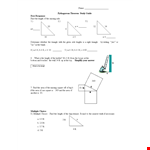
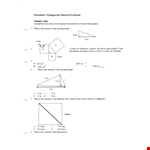
The Pythagorean Theorem formula is a fundamental mathematical concept that relates to right-angled triangles. It states that in a right triangle, the square of the length of the hypotenuse (the side opposite the right angle) is equal to the sum of the squares of the lengths of the other two sides. This theorem is named after the ancient Greek mathematician Pythagoras, who is credited with its discovery.
Understanding and applying the Pythagorean Theorem formula can be extremely useful in various fields, including architecture, engineering, and physics. By using this formula, you can calculate unknown side lengths or determine whether a triangle is a right triangle.
To use the Pythagorean Theorem formula, simply square the lengths of the two shorter sides, then add these squares together. Finally, take the square root of the sum to find the length of the hypotenuse.
Learning and mastering the Pythagorean Theorem formula is essential for anyone working with triangles, whether it's in construction, design, or problem-solving. It provides a reliable and efficient method to solve for unknown side lengths, ensuring precision in your calculations.
So, whether you're a mathematician, engineer, or simply curious about the world of geometry, exploring the Pythagorean Theorem formula is a fascinating journey that opens up a world of possibilities for understanding and solving triangles.